
Electric Strikes
THE MOST COMMON, ELECTRIC LOCKING DEVICE FOR LOW-TO-HIGH SECURITY & TRAFFIC CONTROL
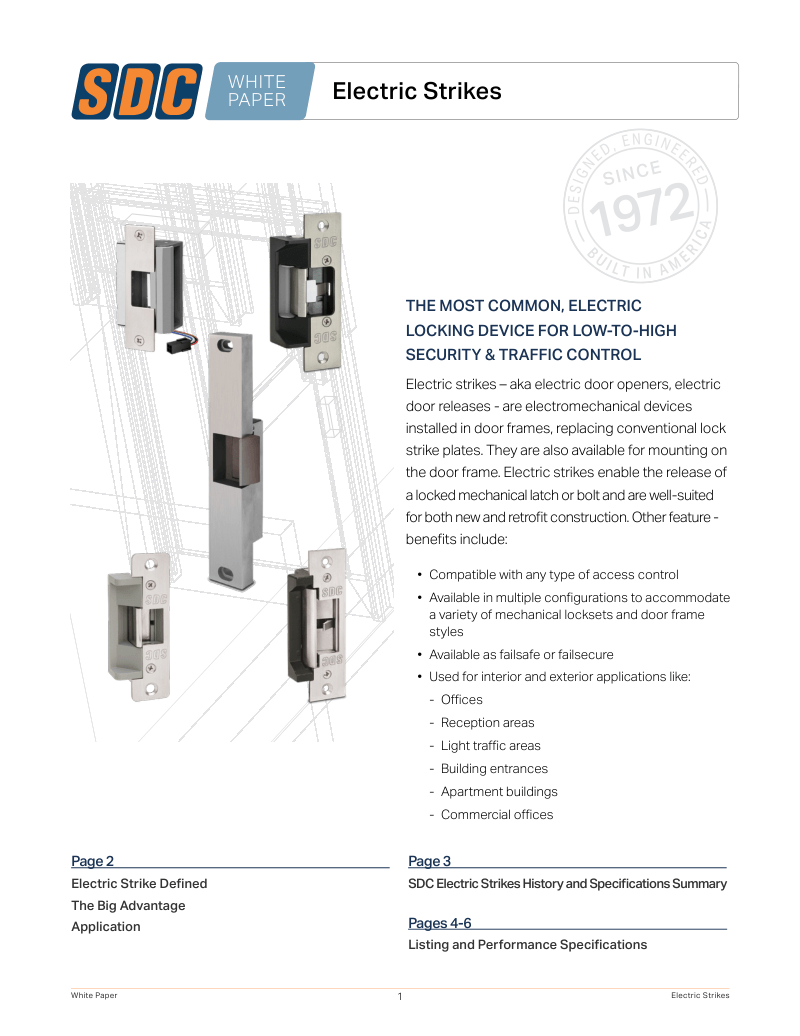
Electric strikes – aka electric door openers, electric door releases – are electromechanical devices installed in door frames, replacing conventional lock strike plates. They are also available for mounting on the door frame. Electric strikes enable the release of a locked mechanical latch or bolt and are well-suited for both new and retrofit construction.
Prefer print?
Download White Paper PDF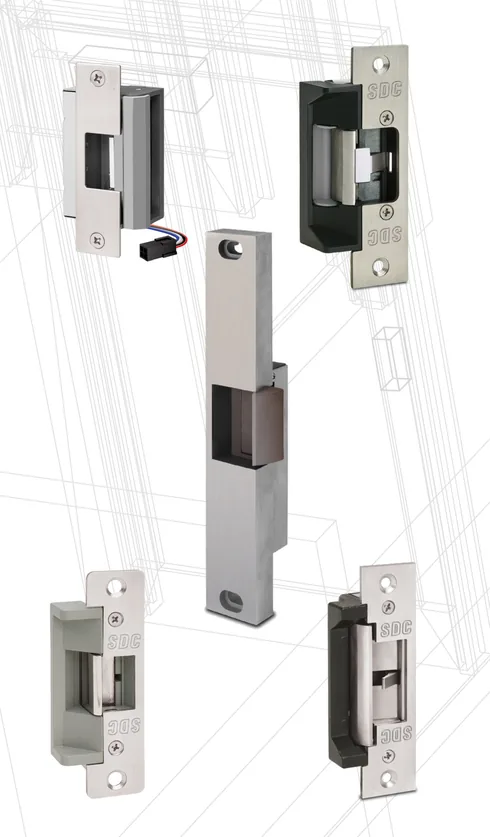
Other feature - benefits include:
- Compatible with any type of access control
- Available in multiple configurations to accommodate a variety of mechanical locksets and door frame styles
- Available as failsafe or failsecure
Used for interior and exterior applications like:
- Offices
- Reception areas
- Light traffic areas
- Building entrances
- Apartment buildings
- Commercial offices
Table of Contents
Electric Strike Defined
Strike – A metal plate located in the door jamb that is pierced or recessed to receive a projected bolt or latch, sometimes called a keeper.
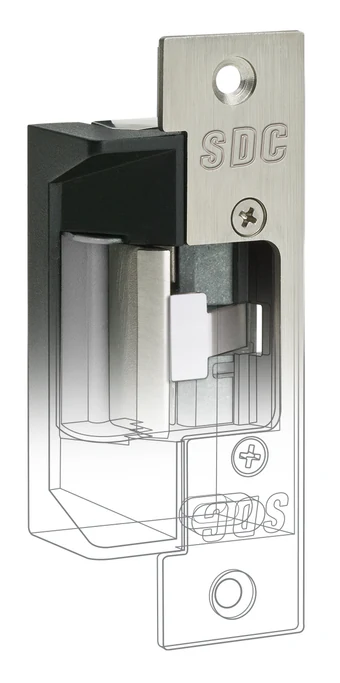
Electric Strike – An electric strike is a jamb mounted electrical device activated by a push switch, keypad or card access control device that controls the locked or deadlocked mode of the movable keeper. When the keeper is locked and the door is closed, the lock's extended latchbolt is captured, keeping the door locked. When electrically activated, the keeper is permitted to pivot – i.e. move out of the way – letting the door lock's extended latchbolt travel freely out of the doorjamb, permitting the door to be pushed or pulled open without turning the knob or lever to retract the latch. Most electric strikes operate in this method by using a built-in solenoid.
Several different electric strike designs are available to work with specific types of mechanical locks, including cylindrical locksets, mortise locksets, deadbolts, and exit devices. Electric strikes are occasionally equipped with a buzzer to indicate when the keeper is released and the door may be opened. Many strikes are also available with built-in monitoring options for latch status, latch and keeper deadlocked status, and deadbolt status.
Failsecure Mode
A failsecure electric strike is locked when de-energized and unlocked when energized by the access control or other type of switching device. Failsecure electric strikes will lock or stay locked during a building power outage. A power supply with battery backup is required to provide unlocking capability during a power loss.
Failsafe Mode
A failsafe electric strike is locked when energized and unlocked when de-energized by the access control or other type of switching device or power loss. Failsafe electric strikes will release the door latch during a building power outage. A power supply with battery backup is required to provide locking capability during a power loss.
The Big Advantage
Electric strikes are possibly used more than any other type of electric locking device due to their ease of installation, cost and compatibility with several types of door locksets and exit devices. All wires are maintained in the lock jamb, unlike electrified locksets that require a power transfer hinge and the chase way running wires through the door to the lockset.
They also provide convenience and remote operation to electrically lock or unlock doors for access and egress control. For example, tenant receptionists can open entrance doors without physically going to the door itself when an electric strike is used.
Application
Failsecure
UL listed failsecure electric strikes may be installed on non-fire rated and fire rated doors and frames. Failsecure strikes are permitted on fire rated doors and frames as all building and fire codes require that fire doors stay latched even when unlocked. This feature ensures that smoke and flame does not travel to other parts of the building.
Failsafe
Failsafe electric strikes may only be installed on non-fire rated doors and frames. Due to their inability to keep the door latched when unlocked, they will compromise the integrity of fire rated doors by allowing the door to open when unlocked, thereby permitting smoke, gases and flames to escape into other parts of the building.
Stairwell Doors
Failsecure electric strikes are not permitted for use on stairwell fire rated doors as they will not unlock the stair side of the door during a fire emergency or power outage as required by fire life safety codes. Stairwell doors are considered two way exits and both sides must unlock in an emergency to provide re-entry by the public and entry by the fire department.
Failsafe strikes may not be used on fire rated doors, including stairwell doors. As these doors are not latched when the failsafe strike is released, fire door integrity is compromised, permitting fire, smoke and gases to travel through the opening.
The proper locking devices for stairwell door applications include ANSI grade 1, failsafe electrified cylindrical or mortise locksets and failsafe mortise exit devices.
For more Electric Strikes product information and resources, visit sdcsec.com/estrikes.
SDC Electric Strikes History & Specifications Summary
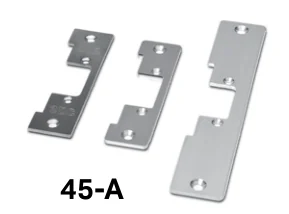
In 1982, SDC's first electric strike design initiated the adoption of strikes by the door hardware industry. Then, we engineered the UniFLEX™ 45 and 55 series – the first electric strikes with interchangeable faceplates and field reversibility for failsafe or failsecure operation. The interchangeable design of these strikes allows SDC to also provide multi-application strike kits that include one electric strike and three faceplates to meet common applications, making them easy to stock and maintain in inventory.
Today, our strikes integrate with a broad range of mechanical locksets, devices, door and frame styles and budgets. Our 45F-4S is a specialty electric strike permitted for use on non fire-rated and fire-rated doors.
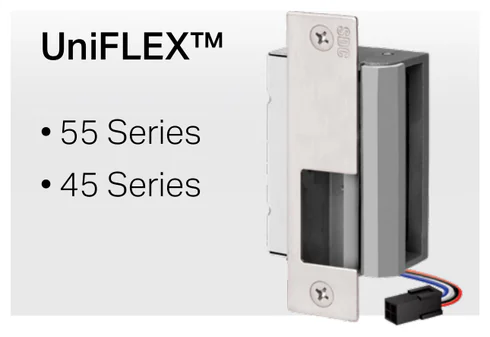
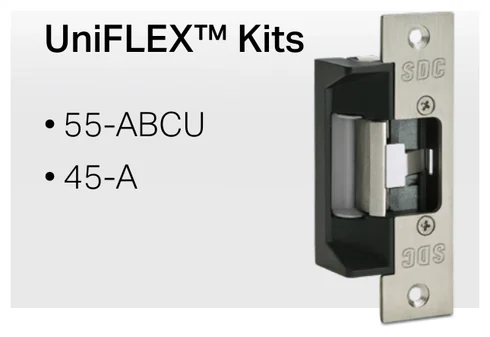
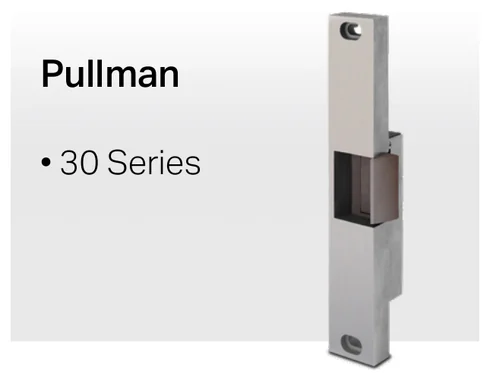
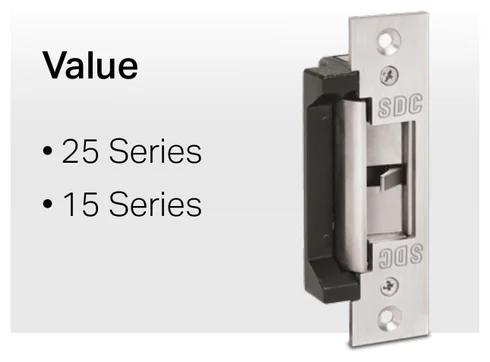
SDC Electric Strikes Specifications Summary
| Series | 15 | 25 | 30 | 45 | 55 |
|---|---|---|---|---|---|
| Trademark | ----- | ----- | ----- | UniFLEX™ | UniFLEX™ |
| Type | Value Cylindrical, ⁵/₈” Latchbolt | Value Cylindrical, ½” Latchbolt | Rim, ¾” Latchbolt | Cylindrical, ⁵/₈” Latchbolt | Mortise, ¾” Latchbolt |
| Adjustable Alignment | ----- | ----- | Yes | Yes | Yes |
| Interchangeable Faceplates | ----- | ----- | ----- | Yes | Yes |
| Multi-Application Kits | ----- | ----- | ----- | Yes | Yes |
| Latch Status (LS) | ----- | Standard | Optional | Standard | Optional |
| Keeper Deadlocked Status | ----- | ----- | Optional | Standard | Optional |
| Keeper Open Status | ----- | ----- | ----- | Optional | ----- |
| Deadbolt Status | ----- | ----- | ----- | ----- | Optional |
| Dual Voltage | ----- | Field Selectable | ----- | Field Selectable | Field Selectable |
| Finishes | 630 | 630 | 630 | 630, 606, 613, 628, 335 | 630, 629, 606, 605, 612, 611, 613, 626, 625 |
| UL | ----- | UL1034 | UL294, UL1034, UL10B, UL10C | UL1034, UL10C | UL1034, UL10C |
| Warranty | 5 Year | 5 Year | 5 Year | 5 Year | 5 Year |
| Buy American | ----- | ----- | ----- | Yes | Yes |
Listing and Performance Specifications
ABOUT ANSI AND BHMA
When choosing a quality electric strike, look for the proper listing and performance specifications. The American National Standards Institute (ANSI) has adopted design and performance standards established by the Builders Hardware Manufacturers Association (BHMA).
ANSI/BHMA Standard A156.31 for Electric Strikes and Frame Mounted Actuators
Purchasers of electric strikes and frame mounted actuators certified to A156.31 can be assured products will perform to their expectations for Durability, Safety & Security, and Appearance. All SDC Electric Strikes* are ANSI/BHMA A156.31 compliant.
*Excludes Series 15 Electric Strikes
BHMA Certification

The Builders Hardware Manufacturers Association (BHMA®) is the only organization accredited by the American National Standards Institute (ANSI) to develop and maintain performance standards for locks, closers, exit devices and other builders hardware. Participants in the BHMA® Certification Program voluntarily submit a hardware product to independent laboratory testing to confirm that the product fully meets the criteria of its ANSI/BHMA standard. In-factory audits are coordinated periodically to assure that products comply to the standard.
REQUIRED UL LISTINGS

The UL Listing confirms that the electric strike design is electrically safe and has been tested for the purpose the product was intended. All electric strikes should meet the following applicable UL test requirements.
- UL Listed – CVXY Burglary-resistant Electric Door Strikes: This category covers burglary-resistant electric door strikes intended to replace standard strikes to be used in conjunction with conventional door latches. Generally, the door can be opened by release of the electric door strike or by mechanical operation of the latch.
- UL Listed – GXAY [Fire Doors] (Hardware) (Builders' Hardware) Electric Strikes: This category covers electric strikes intended to replace the strike plate used in fire door frames of the single-section or two-section type. All products in this category comply with the positive-pressure-test requirements in ANSI/UL 10C, "Positive Pressure Fire Tests of Door Assemblies."
- UL 10C "Positive Pressure Compliant" and Classified in accordance with Uniform Building Code (UBC) "Fire Test for Door Assemblies": This verifies that the lock does not have negative impact on the integrity of fire rated openings. The description will be found on the official UL Listing Auxiliary Lock document.
- UL 294 Access Control System Units: Indicates the electric strike complies in accordance to the construction, performance, and operation of physical access control equipment and/or systems intended to regulate or control:
- Entry into and/or exit from a controlled area, protected area or a restricted area or
- Access to or the use of a device(s) by electrical, electronic or mechanical means.
Canadian Listing: The C preceding the listing symbol indicates that the product is also UL Listed for use in Canada.
The World of Difference Between UL 'Listed' and UL 'Recognized'
UL's Component Recognition Service covers the testing and evaluation of individual components that are incomplete or restricted in performance capabilities. These components will later be used in complete end-products or systems listed by UL. These UL recognized components are not intended for separate installation in the field, they are intended for use as components of complete equipment submitted for investigation and subsequent UL Listing.


